Executive Summary
- Understand the process before selecting a technology solution.
- Measure the baseline with a consistent KPI.
- Focus improvement on the largest service, cost, time or risk gap.
1. What this topic means
Practical inventory guide covering reorder point calculation, process controls, KPIs, examples, common mistakes and implementation steps. The practical objective is to convert the concept into a repeatable process with clear inputs, outputs, controls and ownership.
2. End-to-end framework
3. How to implement it
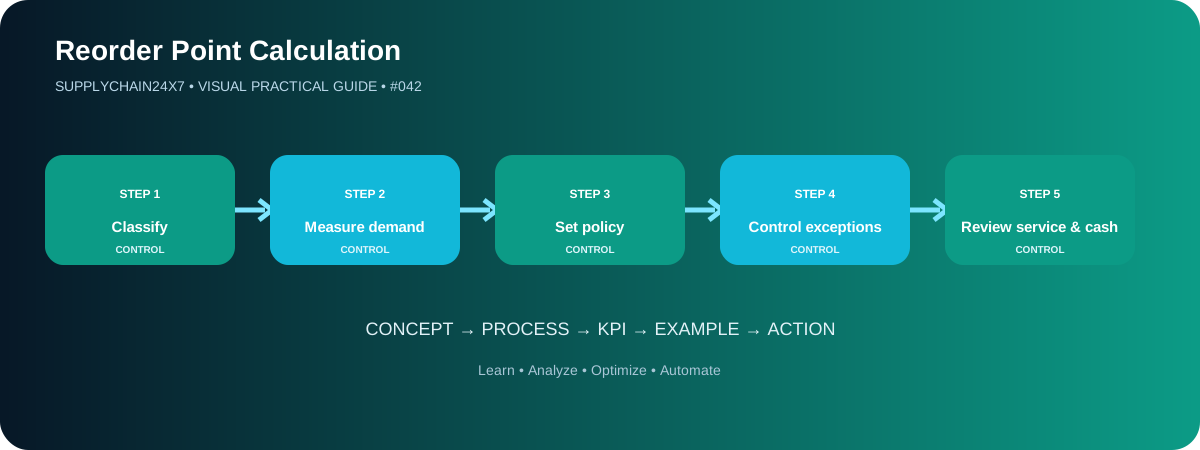
- Classify — document the required data, system transaction, decision rule, exception and owner.
- Measure demand — document the required data, system transaction, decision rule, exception and owner.
- Set policy — document the required data, system transaction, decision rule, exception and owner.
- Control exceptions — document the required data, system transaction, decision rule, exception and owner.
- Review service & cash — document the required data, system transaction, decision rule, exception and owner.
4. Formula / KPI
Use consistent definitions, time windows and data sources.
| Dimension | What to monitor | Management response |
|---|---|---|
| Service | Customer or production impact | Prioritize critical exceptions |
| Cost | Unit and total cost | Attack the largest drivers |
| Time | Cycle time and variability | Remove bottlenecks |
| Quality | Errors, defects or rework | Fix root causes |
5. Worked example
Take one real material, supplier, customer, plant or logistics lane. Capture the baseline, calculate the KPI and compare it against the target. Then identify the top three reasons for the gap.
6. Common mistakes
- Different departments using different KPI definitions.
- Looking only at averages and ignoring variability.
- Reporting exceptions without owners and due dates.
- Automating an unstable process.
- Reducing inventory or cost without checking service impact.
7. 30 / 60 / 90 day action plan
Define scope, data, KPI, baseline and owner.
Implement process controls, dashboard and exception routine.
Automate stable tasks, standardize and verify business impact.
8. Practical checklist
| Checkpoint | Status | Owner |
|---|---|---|
| Process defined | □ | Process Owner |
| Data validated | □ | Data Owner |
| KPI approved | □ | Management |
| Exception rule defined | □ | Planner / Buyer / Operations |
| Review cadence established | □ | Process Owner |
Frequently Asked Questions
What is Reorder Point Calculation?
Reorder Point Calculation is a practical supply-chain topic focused on process understanding, measurable KPIs, decision rules and implementation. The guide translates the concept into actions that can be used in daily operations.
Which KPI should be monitored first?
Start with the KPI that directly connects to the business outcome: customer service, production continuity, cash, cost, quality or delivery. Then standardize its definition and data source.
How can this be improved in practice?
Establish the baseline, identify the largest gap, assign an owner, implement a corrective action, and review the result on a fixed cadence. Automate only after the process is stable.
Key Takeaways
- Standardize the process before automating it.
- Use one KPI definition across the organization.
- Separate normal flow from exceptions.
- Prioritize high-impact materials, suppliers and customers.
- Close the loop by verifying the result.